Wednesday, June 30, 2010

National Geographic Lindblad Trip - Isabela and Fernandina Islands

Check out the photos here.

During the night we went around the north side of Isabela Island and crossed the equator. It happened around 3am so I wasn't up to take notice. However, we rounded the top and headed south so we got to cross it again - all in one day. Surprise, surprise there was not actual line or sign there in the middle of the ocean. However we did spot blue whales (the largest mammal on Earth) and dolphins while doing this motoring around.

After breakfast went went on a panga ride along the cliffs of Punta Vicente Roca. It was quite beautiful. On the way back we saw a huge manta ray swimming along the surface.

Once we arrived back at the boat we quickly changed into our snorkeling gear for a snorkel. We hoped to see sea turtles in the water. The visibility was terrible. However, it was still a good snorkel. First of all a cormorant zoomed right by me in the water. We also saw two large turtles feeding on the rocks. I was watching one for quite a long time. It was right below me. I think that it wanted to come up for air and I had to move quickly to get out of its way. The photos are not as good as I would like due to the visibility but you can definitely see its a turtle.

Later int eh day we sailed towards Fernandina Island. Fernandina is the newest of all the islands and is still volcanically active. The island terrain is marked by ropy or pahoehoe lava flows. Here we saw many more marine iguanas. We had to be careful were we walked to ensure that we wouldn't destroy any of their nesting areas.

On this island there are many flightless cormorants. They lost their ability to fly because there was no need to expend the energy to fly due to the absence of predators on the island. They have these really cute tiny wings. They hold them up to dry just like the regular cormorants even though they don't need to dry them to fly. We were lucky enough to see rays in the water here too.

Walking back we saw the skeleton of a sperm whale. I got an awesome photo of Huichi pretending to chew on one of the ribs. On the way back to the boat we saw a really tiny little sea lion.

Poor little Austin feel asleep before dinner.

National Geographic Lindblad Trip - Floreana Island

From Ecuador


Photos here.

We started the day with a pre-breakfast landing on Floreana Island. There were visited a "post office". This post office had been used for two centuries. People have put mail in a barrel and as other ships passed by they took the mail if it was addressed to someone in their area. I mailed a post card to my Aunt Karen. It has since been hand delivered to her in Connecticut. It arrived before I even left Ecuador. I picked up two post cards for Pagosa Springs because I am hoping to go up and visit a friend who lives up there. Even if I don't I am sure that someone in her family will be heading up that way and can take the cards to her and she can deliver them to the Pagosa residents.

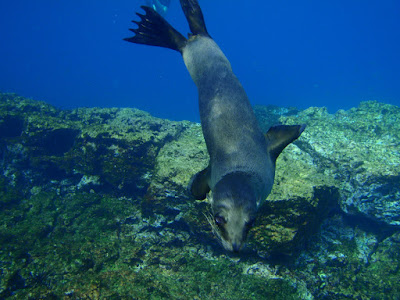
After breakfast we (Huichi, JJ, Erica, Brody, and I) headed off to snorkel off a volcanic cone called Champion Islet. It was a little choppy and Brody stayed in the boat until in calmed down a bit. We did an amazing drift snorkel. This time the sea lions were playing all around us. It was incredible. We topped this off witha glass bottom boat ride.

We had lunch and then Huichi and I went out in the kayaks. We saw a number of sea birds on the rocky shore line. In addition we saw a group of rays swimming along the surface and one or two turtles swimming in the bay.

The day was not yet done. We went for a short walk across the island looking for flamingos. Brody used Dad's camera and took video. Unfortunately, we saw no flamingos. The turtles were nesting and we had to be very careful where we walked. We did find some baby turtle shells. They were not the fittest or luckiest and did not survive. It was a very pretty walk.

National Geographic Lindblad Trip - Espanola Island

From Ecuador


Check out the photos here.

We landed at Punta Suarez on Espanola Island for an "arduous" hike of 1.75 miles. It was probably arduous for my five year old nephew but it was an easy walk with awesome wildlife sighting opportunities for me. There was wildlife everywhere. We saw marine iguanas and sea lions immediately. In fact you need to watch where you walk to ensure that you didn't accidentally walk on one. I was so excited to see an iguana swim. Iguanas are generally thought of as land animals. These found more food in the water and are the only iguana with a marine based food source. Other iguanas may swim to cross a river but these actively enter the water to eat algae. We also saw finches, warblers and mocking birds. As we walked further into the island we viewed the waved albatross. The waved albatross has a large body and is a great flyer but it has difficulty taking off. Generally it must jump off a cliff to take flight. I didn't see any doing this. Instead they were sitting on eggs or doing mating dances where they clicked beaks. Further along we stopped along some high cliffs where a bunch of marine iguanas were hanging out. They must be awesome climbers to get from the water to up there. There were some amazing blowholes a little farther on.

Later in the day we went snorkeling at Gardner Islet. We saw some huge schools of fish. When we snorkeled into a cave were were surprised by sea lions swimming with us. They cruised by at lightening speeds.

National Geographic Lindblad Trip - Baltra and North Seymour Islands

From Ecuador


Check photos here.

It was a big trip to Ecuador for most of my family. After all of the really long trips to and from Australia it wasn't as bad for me. It was 4+ hour flight from PHX to Miami and then a long layover and a 4+ hour flight to Ecuador. The unfortunate thing was that the flight from Miami to Ecuador was greatly delayed. We eventually took off and made it to the hotel in Ecuador. It was the Hilton. It was a big change for me being used to the cheapest hotels and hostels. We didn't get much time to enjoy it though. We got in at 2am and our wake up call was for some extra early time like 5am.

It turns out that my brother-in-law, PJ, and nephew, Brody, sleep like the dead. They had the bolt on in their room and either didn't hear the phone or the ringer was off. Poor Erica was pounding on the door trying to wake them but couldn't get them to get up. She eventually got a key from the front desk but because the bolt was on she could only open the door a few inches. That seemed to help and eventually she woke up one of them and got them going in the morning.

We all had breakfast and then assembled to leave for a flight to the Galapagos Island. It was a typical case of hurry up and wait. Eventually we were told the flight was delay and we had until 9am. I went back to the room and slept. Long flights might not get to me but lack of sleep makes me a bit grumpy.

We eventually landed in Baltra on the Galapagos Island and took a "panga" (zodiac) out to the big ship. This in itself was a bit of an adventure - Dad walking with a cane, PJ can't swim, and Austin (age 5 and not an olympic swimmer) given a life jacket that he could swim in. The ship was great. Dad and I shared a "suite". We had lunch, a lifeboat drill and headed out for our first hike on North Seymour Island .

Now I have to say from here on out that the term hike was used throughout the cruise and the word "walk" was a better description. However, whether a walk or a hike the activity was filled with close encounters with animals. Sea lions met us at the spot the pangas dropped us off. We saw male magnificent frigate birds with their large red neck pouches. We also saw blue footed booby birds. The blue footed boobies were doing mating dances and nesting. North Seymour is one of the only Islands with land iguanas. We saw one or two on the island.

It was great that the staff fit in all of the day's activities even though the flight was late.

Tuesday, June 29, 2010

Volcano Circuit Carihuairazo - Chimborazo - Day 5

From Ecuador


More photos here.

We ate breakfast, packed and headed up Chimborazo. Getting to the top requirs crampons, an ice axe and climbing experience. We were only going up to the next refuge and then past there as far was we could. Raul went with us to make sure we were safe.

The sun was behind Chimborazo as we headed up. It was cold even though we were heading uphill. We visited the Whymper Refuge. After that Raul gave us a choice - head to the Wymper Rocks or to one of the glaciers. We decided to go to the glacier. We were walking on dirt and snow on top of the glacier but got glimpses of the glacier as we went up. Above use we could see the large glacier and ice cascades. It was very beautiful. After awhile Raul said that we had reached the farthest we could go safely. We all hugged and took photos.

After a bit we meandered down a different way and took a group photo using my tripod and camera timer.

At the bottom we snacked, talked and waited for our transport. I felt like I became good friends with Hans and Dien. We had alot of laughs along the way and I feel really lucky to have been able to do the trip with them. Raul was a great guide we were lucky to have him. Raul works for Julio Verne and for himself. His email is raultenemaza@yahoo.es. He is currently developing a web site and if I find out what that is I will include it here at a later date.

Volcano Circuit Carihuairazo - Chimborazo - Day 4

From Ecuador


More photos here.

I think that yesterday we kind of amazed our guide, Raul, when we asked for more places to walk to. We just expected to walk longer than we did. I guess that were were the fittest group that he had had so far because he said that we made much better time than the other groups.

We were only the fourth group to do this trip. It was a new program. Raul was really great and suggested that we walk the fourth and fifth day's distance all today. Then we would walk up Chimborazo on the fifth day before we left. We were all keen to do this as long as we had no altitude problems. We decided to make a decision at lunch when we reached the planned campsite for the day.

Despite it being very cool in the morning, I was very warm walking up, up, up. It was much drier on this side of the mountain. They call it a desert. The air became much thinner and breathing was more and more difficult. At lunch we all felt fine and decided to walk on to the Carrel refuge. I have to say on this day we didn't have alot more energy after reaching our destination but we were happy with our choice.

This refuge was much more crowded. There was a group of taxi drivers there have a big work party. They roasted a pig and were eating that. Of course, there were alot of jokes thrown my way because of the vegetarian thing. We also met a group of doctors from Utah. They were doing a study on the physiology of Ecuadorians related to living and visiting high altitudes. Because the refuge was such a busy place Raul and Diario had to wait to get into the kitchen. Since they prepare everything from scratch dinner took a little while. We were really hungry by the time we got dinner. The refuge had no electricity. Raul set up candles and we ate by candlelight. It was really cozy and nice.

After dinner we all had a touch of altitude sickness - headache and stomach. We went to bed hoping to acclimate overnight.

Volcano Circuit Carihuairazo - Chimborazo - Day 3

From Ecuador


More photos here.

Walking in rubber boots left a couple of sores on my feet. I applied new skin and wrapped the sores with self adhesive tape. At breakfast I asked Raul about wearing my own boots. He said that the first part of the trail was still very wet and I would need to start out in rubber boots. However, he would put our regular boots on top of the horses so we could change into them as soon as the trail conditions improved.

The first part of the trail was very wet and muddy. One horse got really stuck in it and slogged around alot. We were a little worried about it. Dien's shoes were on top of that horse and when she put them on later they had a bit of mud on them from all that thrashing around.

After about an hour were were finally able to swap the rubber boots for our hiking boots. Dien, Hans and I were relieved to have our own shoes back on our feet.

We saw a large group of llamas deep in a glacial valley below us. Raul told us that there were 200 llamas. It turns out that one of our horse handlers, Diario, is part of a 100 person collective that owns those llamas and the land they graze on. The llama is used to make clothing and as a food source. They have one baby a year.

Further on we saw waterfalls and a large lake called the Laguna Cocha Negra. There was no existing glacier there but there had been on in the past. Raul did not remember it but Diario who grew up in that area said that a glacier did exist there when he was young. Climate change is so obvious in the change of the glaciers around the world.

Farther on along the trail we came across another group of llamas. None of the llamas that we saw were wild. They were all domesticated. They have very interesting faces. We were able to get a few photos of these with Chimborazo looming up behind them.

Not too far past there we found our nights lodging - a basic refuge. There were no other travelers there besides us. I had my own room. Dien and Hans (who are married) shared a room with bunk beds. We ate lunch outside in the sun under Chimborazo. It was magnificent.

After lunch we walked down to see the wild vicunas. Vicunas are related to alpacas and llamas. They have much less hair but it is very soft. In Ecuador the Incas only allowed royalty to wear the wool from vicunas. Despite the fact they can survive at very high altitudes they are fragile. They can not live in captivity. They were extinct or nearly extinct in Ecuador. They have been reintroduced from Peru and are now protected.

Vicunas make a strange screeching sound - like a bird or a monkey. They would look at us and make the sound. They they would run (very quickly) away. They are alot faster than llamas who are not slow. We chased them around a boggy area below Chimborazo trying to get good pictures. Mostly I got pictures of their butts has they ran away.